
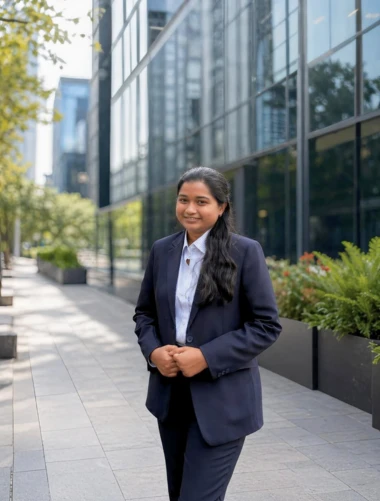
In the final semester, the uncertainty of “What next?” felt uncomfortable. I didn’t want to wait idle for placements, I wanted to use my time productively.
Around then, I came to know about the CII-FM. AA/Control Inst Training Batch-38 from a professor and applied without overthinking. In April, I received the selection mail from Mr C.S. Dhamankar Sir. As I read it, two lines stood out and made me realize I was about to begin something truly meaningful.
“You need to bring along with you an OPEN MIND, which is the most important tool for any learning, besides passion and devotion.”
“Nothing happens unless first a dream. The future belongs to those who believe in their dreams, and in dreams begin responsibilities.”
Those words changed my perspective instantly. I knew this was not just another programme; it was going to be an experience that would shape my thinking, attitude, and approach toward learning and life.
I was appointed as the Class Monitor for Batch 38, selected from 10 aspiring trainees. This responsibility was not merely about coordination it was about leadership, accountability, and communication. I was the link between Sir and the group leaders, and indirectly responsible for ensuring smooth execution across all four phases.
Later During a soft skills session, our class was divided into various functional areas of a business to prepare Excel sheets on KRAs and KPIs. As Class Monitor, I had to coordinate all teams and ensure timely submission to Puranik Sir and Dhamankar Sir.
Managing different working styles was challenging, but we completed everything on time. Later, Sir appreciated me for handling the responsibility efficiently as I was the first class monitor to complete that task among all the batches. That experience taught me that leadership is about ownership, not just position.
The first 15 days were dedicated to structured theory sessions covering the overall product range and functional domains of Forbes Marshall. These sessions helped us understand the fundamentals before stepping into the plant environment. Instead of being directly pushed into operations, we were first made industry-ready in terms of technical orientation which reflected the thoughtfulness behind the programme design.
Before the commencement of Phase-1 of hands-on training, Sir shared a detailed mail outlining the structure of the entire in-plant training. The batch was strategically divided across different work areas at MIDC Pimpri and Chakan, with planned rotations to ensure balanced exposure.
The rotational structure across functional manufacturing areas like Krohne, ARCA, ABCC (Analytical, BHD, Codel, Controls) and Integrated Solutions (Projects, SWAS, Shinkawa, DCS) ensured that we didn’t just observe but we experience cross-functional exposure. This helped us understand how different departments integrate to deliver a complete solution.
The weekly Wednesday technical sessions and soft-skill workshops also added great value. They improved our communication, confidence, and overall professional approach. Slowly, I could feel myself becoming more responsible and more confident in expressing my thoughts.
Another valuable experience was the extended learning phase, where I was exposed to the actual user business of Shinkawa Sales. This phase gave me insight into how products are not just manufactured but also positioned, explained, and delivered to end users. I understood how technical knowledge connects with customer requirements and business strategy. It broadened my perspective beyond manufacturing and helped me appreciate the commercial and application side of engineering solutions.
This systematic approach made me realize that CII-FM was not just a training programme but it was a carefully curated bridge between academia and industry.
Another helpful experience was the individual SWOT analysis conducted personally by Dhamankar Sir for each of us. It was not just a formality. It was an honest and thoughtful discussion about our strengths, weaknesses, opportunities, and areas of improvement. It made me reflect deeply on myself. I became more aware of where I stand and what I need to work on. I believe this session helped everyone in the batch gain clarity and direction.
When I joined CII-FM training, my intention was simply to stay productive after graduation. But by the end of the programme, I realized it had given me much more industry exposure, leadership experience, self-awareness, and confidence.
CII-FM training did not just prepare me technically; it changed the way I look at responsibilities and growth. I am truly grateful to Dhamankar Sir and the entire team at Forbes Marshall for guiding us and believing in us throughout this journey.
Currently, I am pursuing an MBA in Finance, and I believe the learnings from CII-FM training have strengthened my foundation for this next phase of my professional journey.
Aishwarya Babar
CII-FM Affirmative Action Batch-38
Pune
