

Process Actuators and Controllers in Instrumentation Engineering
In industrial process automation, actuators and controllers are components that regulate, automate, and optimise system operations. These devices continuously manage process variables such as temperature, pressure, fluid flow, and tank levels by adjusting inputs based on real-time feedback from sensors.
The integration of controllers and actuators creates a closed-loop control system, enabling safe, precise and efficient operations across plants in industry sectors such as power generation, water treatment, chemical processing, and oil and gas.
How Controllers and Actuators Interact in The Control Loop
We have to look at the industrial control loop to understand how controllers and actuators work together. The process follows a continuous four step cycle:
- Measurement: Sensors or transmitters measure the current state of a process variable like temperature. For e.g., a temperature sensor reads 150°C.
- Evaluation: The process controller compares this real-time measurement against a predefined target called the setpoint. If an error exists, the controller calculates the required corrective action.
- Actuation: The controller sends an electrical, pneumatic, or digital command signal to the process actuator.
- Correction: The actuator physically moves a final control element such as a valve to bring the process variable back to the setpoint.
What Are Process Actuators?
A process actuator is a mechanical device that converts an electrical, pneumatic, or hydraulic control signal into a mechanical movement or physical motion. Actuators act as the final execution mechanism in an automation loop, manipulating valves, dampers, fluid drives, or louvers to regulate material and energy flows.
Types of Industrial Actuators
Actuators are categorised by the source of energy they use to generate mechanical force.
Pneumatic Actuators
Pneumatic actuators use compressed air to generate mechanical motion by converting it into linear or rotary motion. They are the industry standard and are widely used in applications that require quick, accurate responses, and are particularly common in processes where clean, reliable power sources are needed.
- Working Principle:
Compressed air applies pressure against a flexible diaphragm or a piston, compressing an internal spring and moving a valve stem. The compressed air pressure is adjusted based on the control signals from the controller. - Advantages:
Pneumatic actuators exhibit rapid response times and are inherently suitable for explosion proof and safe for hazardous environments as they do not generate any electrical spark. These actuators are durable with simple mechanical design requiring minimal maintenance. - Applications:
Fast-acting shutdown valves, refinery control valves, and HVAC dampers. Hydraulic Actuators
Hydraulic actuators use pressurised liquids, typically synthetic oils to generate mechanical motion. They are capable of exerting a large amount of force, making them ideal for heavy-duty industrial applications.
- Working Principle:
Hydraulic actuators consist of a cylinder or piston mechanism that is moved using hydraulic fluid under pressure. A high-pressure hydraulic pump forces fluid into a cylinder, driving a heavy duty piston forward or backward. The fluid’s pressure is controlled by a hydraulic pump that is regulated by the control system. - Advantages:
Hydraulic actuators are capable of producing immense force, highly precise positioning and exceptional power-to-weight ratio. - Applications:
Hydraulic actuators are used for controlling main isolation valves in upstream oil and gas pipelines, heavy subsea machinery, and heavy industrial machinery like forging presses. Electric Actuators
Electric actuators rely on electric motors and gear trains to precisely position final control elements. They are preferred due to their precision and ease of integration with modern control systems.
- Working Principle:
Electric actuators convert electrical energy into mechanical motion using a motor (DC or AC). The motor drives a series of gears or or a lead screw to actuate a valve stem or rotary shaft based on digital or analog control signals. - Advantages:
Electric actuators offer high precision and accuracy with seamless integration with modern digital control networks. They require lower maintenance compared to pneumatic and hydraulic systems. The consume low energy when stationary requiring no infrastructure for auxiliary air or fluid. - Applications:
Flow control in water treatment facilities, precise chemical dosing pumps, and automated manufacturing assembly lines. Thermal Actuators
Thermal actuators operate based on thermal expansion or contraction of materials, typically used in temperature control systems.
- Working Principle:
Thermal actuators use the expansion and contraction of a temperature-sensitive substance often a wax element that changes its state in response to temperature changes. This movement is used to open or close valves or dampers. - Advantages:
Thermal actuators feature a simple and compact design. They are entirely self-contained and self-operating without external power and highly reliable for specific temperature ranges requiring no external power. - Applications:
Thermal actuators are used in thermostatic valves in heating systems and automotive cooling systems, and safety freeze-protection valves.
| Actuator Type | Power Source | Speed | Force/Torque Output | Best Suited For |
|---|---|---|---|---|
| Pneumatic | Compressed Air | Very Fast | Moderate | Hazardous environments & rapid cycling |
| Hydraulic | Pressurized Oil | Moderate | Extremely High | Heavy-duty applications & massive valves |
| Electric | Electricity | Slow to Moderate | High | Digital precision & infrastructure-light plants |
| Thermal | Temperature Change | Slow | Low | Self-contained temperature regulation |
What Are Process Controllers?
While actuators provide the muscle, process controllers provide the intelligence. A process controller reads input signals from sensors, computes the variance from the setpoint, and determines the exact signal to send to the actuator.
Types of Process Controllers
- Programmable Logic Controllers (PLCs)
PLCs are rugged, microprocessor based computers designed to handle discrete and continuous industrial automation tasks. They excel at high speed logic, safety interlocking, and controlling localised machinery. - Distributed Control Systems (DCS)
A DCS is a centralised control network used for complex, plant-wide processes. Instead of a single controller managing everything, control tasks are distributed across multiple autonomous controllers throughout the plant, connected to a central operator interface like SCADA. They are preferred in large scale continuous processes like oil refineries. - PID Controllers (Proportional-Integral-Derivative)
A PID controller is a control loop feedback mechanism widely used in industrial control systems. It continuously calculates an error value as the difference between a desired setpoint (SP) and a measured process variable (PV) and applies a correction based on proportional, integral, and derivative terms:
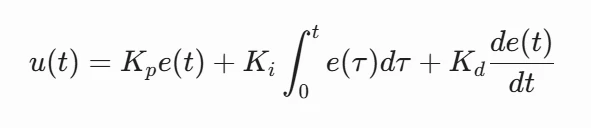
Where
- Proportional (P): Corrects based on the current size of the error.
- Integral (I): Corrects based on the accumulation of past errors to eliminate steady-state offset.
- Derivative (D): Corrects based on the predicted future trajectory of the error, slowing down changes to prevent overshoot.
Frequently Asked Questions
- What is the difference between an actuator and a controller?
A controller is the electronic brain that evaluates process data and calculates corrections. An actuator is the mechanical muscle that receives commands from the controller and physically moves a valve or damper to change the process. - What does fail-safe mode mean in industrial actuators?
Fail-safe refers to the default position an actuator returns to if it loses its primary power source (electricity or air). For safety reasons, actuators are engineered to be Fail-Open (FO), Fail-Closed (FC), or Fail-Last/Lock-in-Last-Position (FL) depending on the requirements of the process. - Why are pneumatic actuators preferred over electric actuators in industries like chemical and fertilizers?
Pneumatic actuators run on compressed air rather than electricity. This eliminates the risk of electrical sparks, making them inherently safer in volatile or hazardous environments where flammable gases are processed.
