

Building a resilient India – Naushad’s opinion column in Business Standard
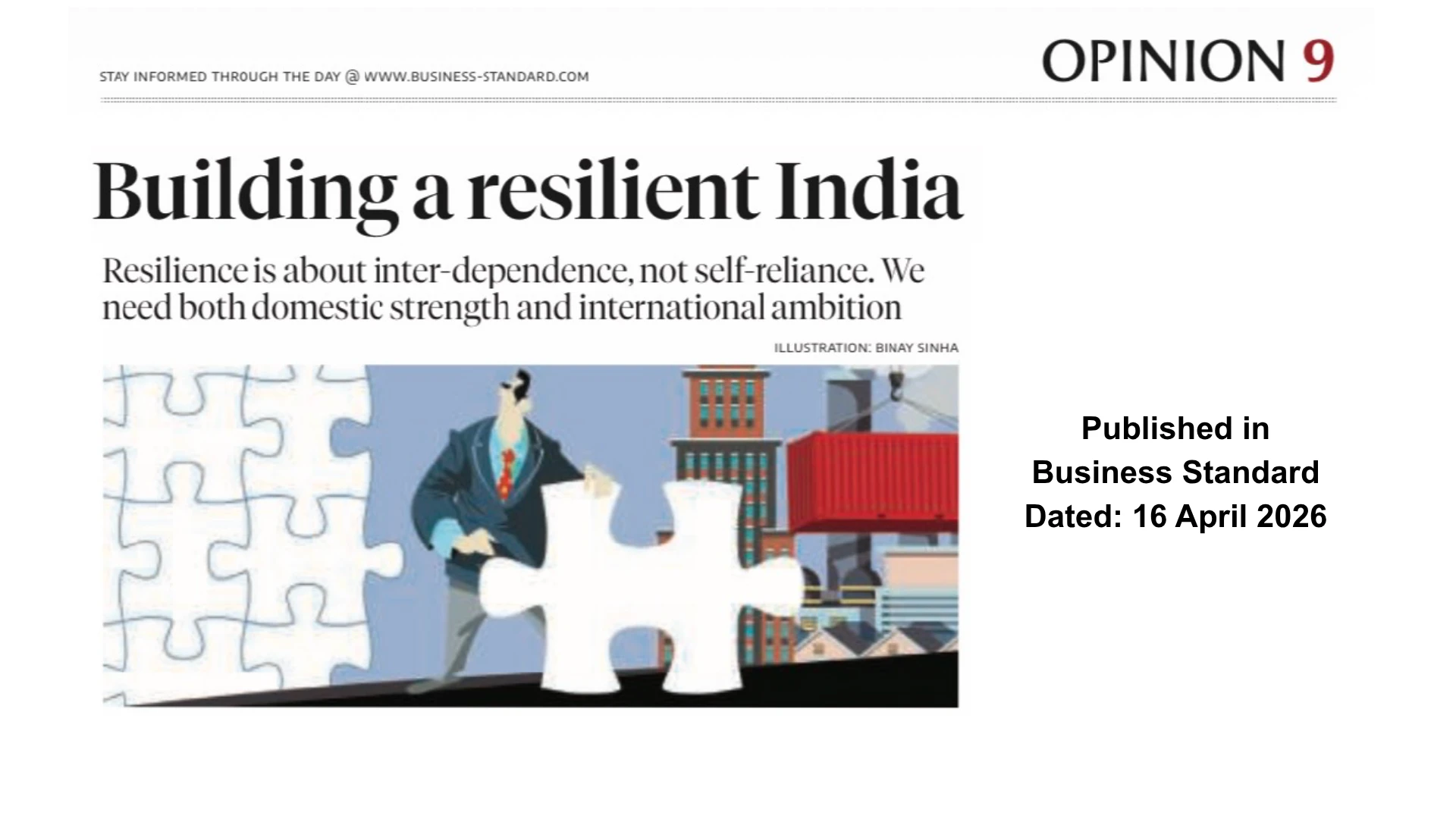
Building a resilient India
Resilience is about inter-dependence, not self-reliance. We need both domestic strength and international ambition
An old Chinese curse says, “May you live in interesting times.” It wishes “disorder, uncertainty, and turmoil” on the recipient. That about sums up the world in these last six weeks, as the United States and Israel have played soldiers, substituting plastic guns with their combined armed forces. The war has led to shortages of gas, widespread supply chain disruptions, and a huge jump in oil prices. How can we deal effectively with this world of uncertainty, turmoil, and disorder? As we deal with the immediate challenges, we need to address our need for long-term resilience. That is my focus in this article.
An immediate instinct is to turn inwards and seek self-reliance. But the world, and certainly India, is too dependent on other countries for that to be an effective strategy. After Galwan in 2020, we tried to reduce reliance on China. We imposed restrictions on foreign investment and tried to limit imports. What happened? Our exports of goods to China stagnated at under $20 billion; our imports from China doubled, from $60 billion to over $120 billion, leading to a record trade deficit of $100 billion.
The alternative to self-reliance is inter-dependence. We will remain dependent on others — for energy, for specialised machinery, for aircraft, for intermediate chemicals, for certain electronic components. What we should seek is that others are as dependent on us, for things only we can provide, or for products or costs that are distinctly better. There we have work to do. India must matter much more to the world. That demands both domestic strength and international ambition.
Building strength at home
The medium-term fundamentals of our economy are sound: Decent growth, low inflation, ample foreign exchange reserves, and robust bank and company balance sheets. So, while we cope with current disruption, we must work on the longer term. Domestic strength will come from a strong economy built on world-competitive and ambitious firms.
For firms to do the right thing, we need the right firms. This is a matter of structural change. Competitiveness needs to be forced through policy. The best way is by being open to imports from the best in the world. Going further, a good test of a truly competitive firm is exports: Can we successfully compete for our core business with the world’s best on their home ground? The reforms post-1991 were characterised by churn in firms, with the exit of less competitive firms and more successful ones prospering. Whole new sectors such as information technology (IT) services and the pharmaceutical industry rose to prominence, producing some of our most successful firms. Their competitiveness was proven by success in world markets. That churn decreased from the 2000s; we need to trigger it again. Exit is the essential partner of entry.
We must invest in proprietary technology. As this column has long argued, Indian industry needs to greatly increase its investment in in-house research & development (R&D). A good numerical target is to grow in-house R&D five times from our current 0.3 per cent of gross domestic product (GDP) to the world average of 1.5 per cent. But even more useful is to undertake some serious benchmarking with the top 10 or 20 firms in one’s industry. How much do they invest as a percentage of sales? How many people do they have in R&D? With what qualifications? And what output does their R&D provide each year—what new products, what patents and design registrations, what entry into new businesses and markets? And aim to do better on all these metrics.
Most of this is about what firms must do themselves, supported by a policy environment that fosters competition. To build strength at home, industry and the state have equally important roles to play.
Building strength abroad
The other side of domestic strength is international ambition. Our flurry of free trade negotiations is welcome. We must use our free trade agreements (FTAs) to build a stronger strategic relationship in general. Our close relationships in West Asia should help us engage deeply in the reconstruction and recovery of the region from the war. The European Union FTA is an opportunity for Europe and India to deepen ties across everything from defence and education to culture. We need, though, a deepening of foreign relations with much of Asia. Our policy of Act East must go
from a slogan to, well, actually acting. At a minimum, we could renew and strengthen existing trade agreements with the Association of Southeast Asian Nations, Japan, and South Korea. We could evaluate joining the Comprehensive and Progressive Agreement for Trans-Pacific Partnership, which brings together 11 major economies around the Pacific and a geographically challenged United Kingdom. It is a deep and wide agreement, with a high bar for everything from government procurement to investment. Studying what must change for us to qualify could identify useful domestic reforms, even if we conclude it isn’t yet in our national interest.
We claim to speak for the Global South; the Global South seems to have missed that. A useful approach might be a joint position in the World Trade Organization and the United Nations, and to expand ties and trade across Africa. And we need a new interest in Latin America, where there is great resonance in many areas, including the importance of family business and a heterogenous society that accords equal importance to family ties.
While the state could lead in ensuring close relationships with all those countries that matter to us, industry must follow that lead with investment overseas. Our ambition in industry should be to build a strong international presence. How do our leading firms become comfortable operating in Europe, Southeast Asia, Africa, Latin America and West Asia, all at the same time? Confederation of Indian Industry delegations to countries as varied as Sri Lanka, Indonesia, the UK, Oman and Egypt have received a message that Indian firms are being actively sought. We need to build on this welcome, recruiting local managers and local teams. There really is a whole world out there. The rest of Asia, without China, is three times our GDP. West Asia,
Turkey and Africa would add over $5 trillion, and Latin America over $7 trillion. Add those together and we have a market bigger than the US or China. The EU doubles that.
Today, our IT services, pharmaceutical, and a few specialised firms in the textile and garment, auto-component, and engineering industries have a significant international presence. Indian industry writ large must follow their lead. Many of our international firms are quite dependent on the US market and need to diversify — Mr Trump’s tariff games of the last year have been a useful prompt.
A combination of domestic strength and international ambition can build dependence on India. By working in tandem, government policy and Indian industry can make India matter to the world and deliver an inter-dependent future.
Naushad Forbes
ndforbes@forbesmarshall.com
Co-Chairman Forbes Marshall, Founding Member Nayanta University, Past President CII, Chairman of Centre for Technology Innovation and Economic Research. His book The Struggle and the Promise has been published by HarperCollins.
(Published in Business Standard dated 16th April 2026)
