

One Path to Prosperity – Naushad’s opinion column in Business Standard
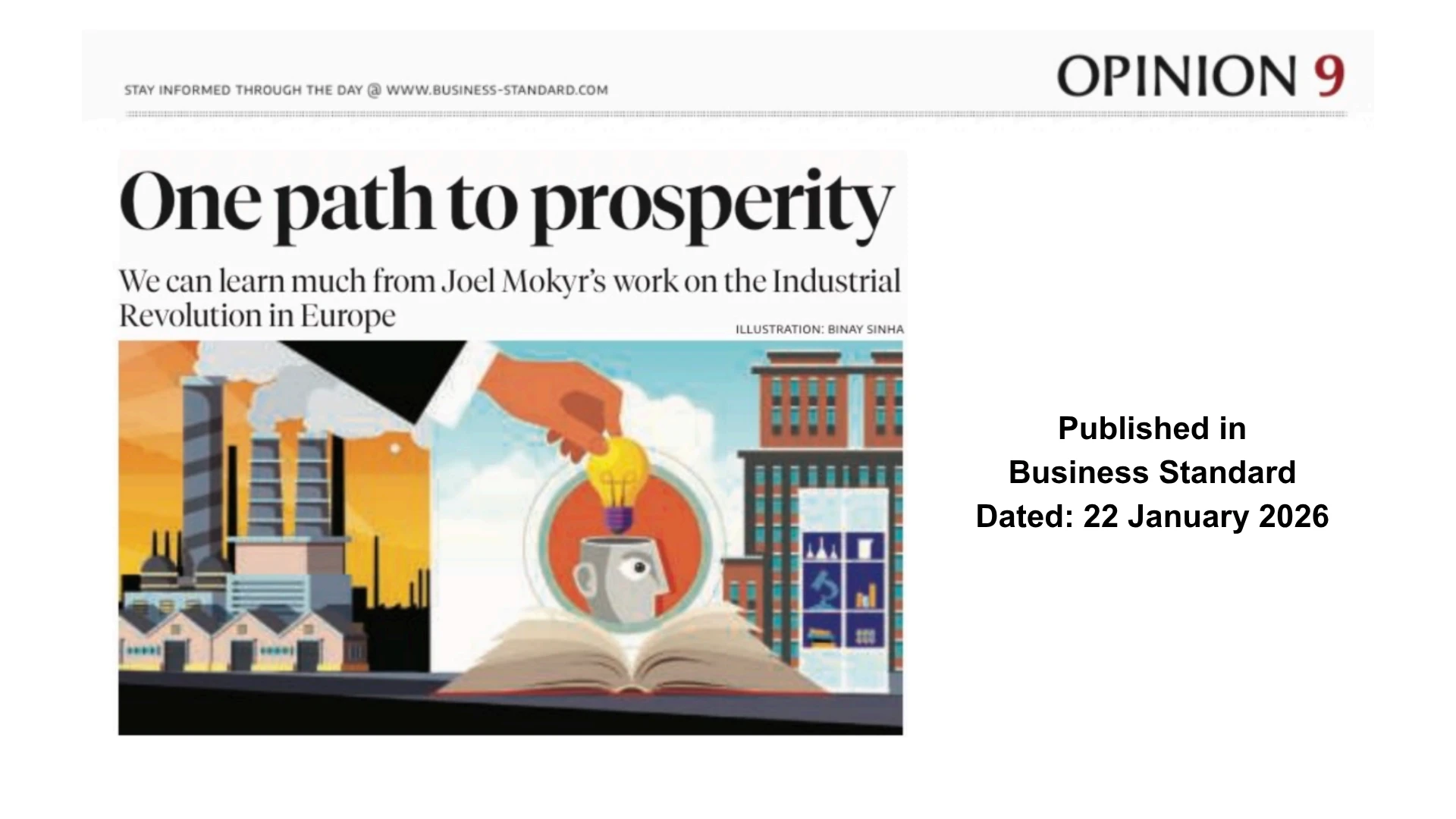
One path to prosperity
We can learn much from Joel Mokyr’s work on the Industrial Revolution in Europe
This year’s Nobel prize in economics was awarded to Joel Mokyr, Philippe Aghion and Peter Howitt, for explaining how innovation drives economic growth. Dr Mokyr, who received half the prize, is known for many great books that explain how countries develop through long-run technical change and industrialisation.
Dr Mokyr’s story of the Industrial Revolution is that of the gradual accumulation of knowledge. Much of this knowledge, especially in Britain, was what he calls prescriptive knowledge, the kind that came up with a more efficient steam engine or a better way of spinning cotton. That is a well-known story, told by many others before him. The new machinery was ingenious, but not based on scientific discovery. It was the result of tinkering, sometimes for years, by skilled artisans. Dr Mokyr’s insight shows that science still played an essential role as a body of knowledge and a way of thinking, contained in the heads of inventors as they tinkered away. By using scientific approaches of experimentation and documentation, combined with great artisanal originality, entrepreneurs were able to sustain technological innovation and deliver long-run economic progress.
Joel Mokyr has just co-authored a new book, Two Paths to Prosperity: Culture and Institutions in Europe and China, 1000 – 2000, that is very interesting reading. The book should be titled One Path to Prosperity; the penultimate chapter on modern China is quite unsatisfying in illustrating anything like a second path to prosperity. The main story, however, of the sources of the industrial revolution in Europe is deeply satisfying. Cultural attributes initiated institutional change, which in turn reinforced benign cultural attributes. This cultural and institutional development in Western Europe triggered the accumulation of scientific and artisanal knowledge that formed the foundation for the technical change of the Industrial Revolution of the 18th and 19th centuries.
Dr Mokyr and his co-authors, Avner Greif and Guido Tabellini, argue that Europe’s fragmented polity fostered innovation. Innovation changes the status quo. This often upsets incumbents, who may have political power or influence. In fragmented Europe, an innovator who upset the influential to the point of reprisal could move to
another country next door. In China, they could not escape the reach of the central government. The growth of local government with real power and resources in European cities supplemented the supply of safe havens. Cities saw it as a badge of pride to attract the best and brightest from home and abroad to settle there. Scientific societies sprung up across Europe, spreading a scientific temper and approach, with new theories based on observation and experiment replacing old theories based on dogma. This scientific temper diffused beyond scientists themselves to wider elites in politics, in trade, in city government. The spread of these new ways of thinking was critical to the support entrepreneurs received as they challenged the power of incumbents. An environment of exchange and contestation fostered the accumulation of layers of accepted knowledge.
These insights are important not just for understanding Europe and China two, five and ten centuries ago. They matter to us in India, as we seek to achieve developed country status by 2047. We need that same fruitful interplay of cultural attitudes and institutions that provides the foundation for technical change. High growth rates would result.
Rapid growth requires social capital, which has hard and soft components. The hard components are the education and skill levels of the population. A high quality school education system is probably the single most important thing for long-run progress. Skills of productivity and tacit knowledge in the wider workforce come from work experience. China now accounts for one-third of the world’s manufacturing output, and with it the ability to deploy the widest range of entrenched manufacturing skills in every industry. That’s our competition. We need serious investment by firms in millions of manufacturing jobs that build skills and a work ethic. Our recent investments in phone assembly, now employing over 200,000 people, is a start — but it’s only a start.
A softer component of social capital is as important. An idea of progress developed in Europe, and with it a hunger for development. More and more individuals believed they had agency and that life would get better for each succeeding generation. India has this hunger in spades. Since 1991, more and more of us have also begun to believe we have the agency to improve our own lives. We are still not the majority;
too many of us think it is the government or some great-and-good leader who will make life better for us. So we have work to do.
There is a third learning from recent economics Nobels: Creative destruction. The pair who received the Nobel with Dr Mokyr, Aghion and Howitt, were cited for their work on creative destruction. The Industrial Revolution both drove great progress and caused great misery as skilled workers were thrown out of work by new technology. There was an abiding belief that aggregate employment would keep increasing, even as individual professions vanished. The data proved that belief to be right. No one suggests that we follow a similar path that was as cruel as it was powerful: We need safety nets, adjustment programmes, and retraining schemes as new technology disrupts incumbent employment. But we need an appetite for the technical change that must drive rapid progress, that must destroy as it creates. Our Insolvency and Bankruptcy Act was passed in 2016, promising to speed up just such restructuring. But take just one industry, airlines: Jet Airways stopped flying in 2019 and Go First in 2023. Planes from both airlines still dot our airports. The result is an incumbent with 60 per cent of the market – and the ability to cause chaos across the entire industry when it does not prepare for a long-announced regulation. We do not destroy, so we do not create.
Europe’s current malaise seems to stem in no small part from it having substantially lost its hunger for development. And with it, its tolerance for creative destruction, choosing to hang onto old professions and incumbent firms. Current tariff policy in the US is taking it in exactly that direction.
A developed India demands that we do better. That we invest in quality education as a society. That entrepreneurs in both manufacturing and services invest in the capacity and employment that skills our wider workforce. That we as a society have faith in the idea of progress, that we have a better future, and that the responsibility for delivering that better future rests with ourselves and not the government. And that we embrace the creative destruction that replaces inefficient incumbents with more nimble competitors.
Naushad Forbes
ndforbes@forbesmarshall.com
Co-Chairman Forbes Marshall, Founding Member Nayanta University, Past President CII, Chairman of Centre for Technology Innovation and Economic Research. His book, The Struggle and the Promise has been published by HarperCollins.
