
Forbes Marshall - Trusted Partners in Steam Engineering & Control Instrumentation

Radar (FMCW) Level Transmitters

Krohne Marshall’s range of radar level transmitters offer non-invasive measurement for liquids, pastes, granules, powders, and various solids. The radar principle used in these level meters is FMCW (Frequency Modulated Continuous Wave). They can measure distances of up to 100 meters (328 feet) and come with various antenna configurations designed for corrosive or abrasive substances, high pressure, high temperature, and agitator applications. They are also suitable for hazardous environments, functional safety (SIL), and hygienic uses.

What are Radar (FMCW) Level Transmitters ?

Radar (FMCW) Level Transmitters are designed for the non-contact, continuous measurement of levels in liquids, pastes, slurries, and bulk solids. These devices function using the Frequency Modulated Continuous Wave (FMCW) method, where a high-frequency radar signal is emitted with a frequency that rises linearly across a set bandwidth. As this radar wave bounces off the surface of the medium, the transmitter determines the precise frequency gap between the outgoing and incoming signals. This difference in frequency is directly proportional to the distance from the sensor. By employing Fast Fourier Transform (FFT) within an internal digital signal processor, the device can then calculate highly precise data for level, volume, or mass.

Advantages of FMCW radar technology

FMCW radar technology offers a key benefit i.e. outstanding reliability within challenging process environments. These transmitters remain entirely unaffected by changes in temperature, pressure, density, viscosity, or surface foam because their measurements rely on time-of-flight distance rather than the physical characteristics of the media. Furthermore, FMCW radar uses a broad dynamic range and high signal dynamics to provide precise, stable readings even for low-reflective media, while successfully filtering out false echoes caused by tank internal structures.
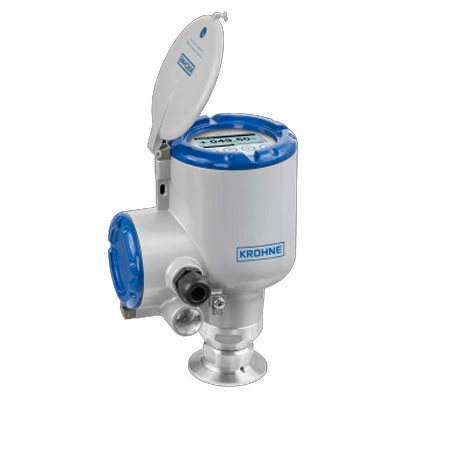
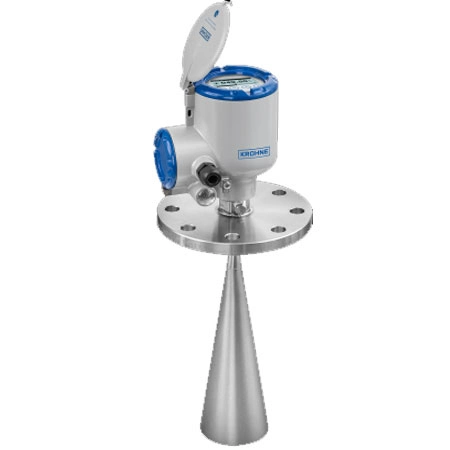
Krohne Marshall’s range of radar level transmitters offer non-invasive measurement for liquids, pastes, granules, powders, and various solids. The radar principle used in these level meters is FMCW (Frequency Modulated Continuous Wave). They can measure distances of up to 100 meters (328 feet) and come with various antenna configurations designed for corrosive or abrasive substances, high pressure, high temperature, and agitator applications. They are also suitable for hazardous environments, functional safety (SIL), and hygienic uses.

What are Radar (FMCW) Level Transmitters ?

Radar (FMCW) Level Transmitters are designed for the non-contact, continuous measurement of levels in liquids, pastes, slurries, and bulk solids. These devices function using the Frequency Modulated Continuous Wave (FMCW) method, where a high-frequency radar signal is emitted with a frequency that rises linearly across a set bandwidth. As this radar wave bounces off the surface of the medium, the transmitter determines the precise frequency gap between the outgoing and incoming signals. This difference in frequency is directly proportional to the distance from the sensor. By employing Fast Fourier Transform (FFT) within an internal digital signal processor, the device can then calculate highly precise data for level, volume, or mass.

Advantages of FMCW radar technology

FMCW radar technology offers a key benefit i.e. outstanding reliability within challenging process environments. These transmitters remain entirely unaffected by changes in temperature, pressure, density, viscosity, or surface foam because their measurements rely on time-of-flight distance rather than the physical characteristics of the media. Furthermore, FMCW radar uses a broad dynamic range and high signal dynamics to provide precise, stable readings even for low-reflective media, while successfully filtering out false echoes caused by tank internal structures.
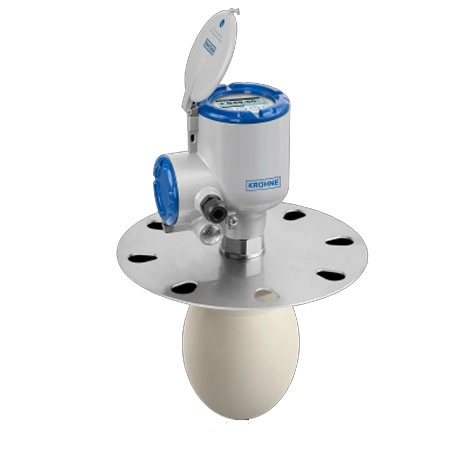
  • OPTIWAVE 3500 C

    Krohne Marshall’s range of radar level transmitters offer non-invasive measurement for liquids, pastes, granules, powders, and various solids. The radar principle used in these level meters is FMCW (Frequency Modulated Continuous Wave). They can measure distances of up to 100 meters (328 feet) and come with various antenna configurations designed for corrosive or abrasive substances, high pressure, high temperature, and agitator applications. They are also suitable for hazardous environments, functional safety (SIL), and hygienic uses.

    What are Radar (FMCW) Level Transmitters ?

    Radar (FMCW) Level Transmitters are designed for the non-contact, continuous measurement of levels in liquids, pastes, slurries, and bulk solids. These devices function using the Frequency Modulated Continuous Wave (FMCW) method, where a high-frequency radar signal is emitted with a frequency that rises linearly across a set bandwidth. As this radar wave bounces off the surface of the medium, the transmitter determines the precise frequency gap between the outgoing and incoming signals. This difference in frequency is directly proportional to the distance from the sensor. By employing Fast Fourier Transform (FFT) within an internal digital signal processor, the device can then calculate highly precise data for level, volume, or mass.

    Advantages of FMCW radar technology

    FMCW radar technology offers a key benefit i.e. outstanding reliability within challenging process environments. These transmitters remain entirely unaffected by changes in temperature, pressure, density, viscosity, or surface foam because their measurements rely on time-of-flight distance rather than the physical characteristics of the media. Furthermore, FMCW radar uses a broad dynamic range and high signal dynamics to provide precise, stable readings even for low-reflective media, while successfully filtering out false echoes caused by tank internal structures.
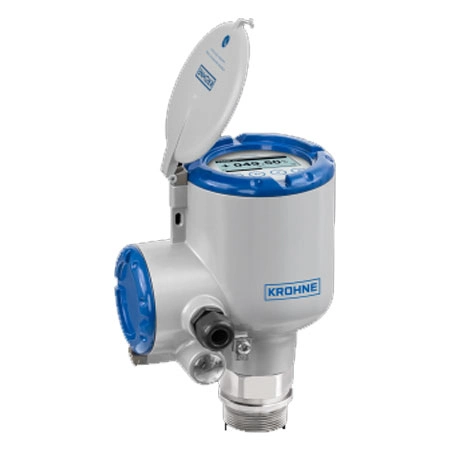
  • OPTIWAVE 5400 C

    Krohne Marshall’s range of radar level transmitters offer non-invasive measurement for liquids, pastes, granules, powders, and various solids. The radar principle used in these level meters is FMCW (Frequency Modulated Continuous Wave). They can measure distances of up to 100 meters (328 feet) and come with various antenna configurations designed for corrosive or abrasive substances, high pressure, high temperature, and agitator applications. They are also suitable for hazardous environments, functional safety (SIL), and hygienic uses.

    What are Radar (FMCW) Level Transmitters ?

    Radar (FMCW) Level Transmitters are designed for the non-contact, continuous measurement of levels in liquids, pastes, slurries, and bulk solids. These devices function using the Frequency Modulated Continuous Wave (FMCW) method, where a high-frequency radar signal is emitted with a frequency that rises linearly across a set bandwidth. As this radar wave bounces off the surface of the medium, the transmitter determines the precise frequency gap between the outgoing and incoming signals. This difference in frequency is directly proportional to the distance from the sensor. By employing Fast Fourier Transform (FFT) within an internal digital signal processor, the device can then calculate highly precise data for level, volume, or mass.

    Advantages of FMCW radar technology

    FMCW radar technology offers a key benefit i.e. outstanding reliability within challenging process environments. These transmitters remain entirely unaffected by changes in temperature, pressure, density, viscosity, or surface foam because their measurements rely on time-of-flight distance rather than the physical characteristics of the media. Furthermore, FMCW radar uses a broad dynamic range and high signal dynamics to provide precise, stable readings even for low-reflective media, while successfully filtering out false echoes caused by tank internal structures.
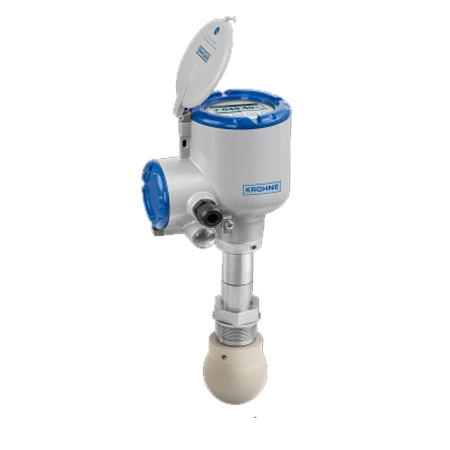
  • OPTIWAVE 6400 C

    Krohne Marshall’s range of radar level transmitters offer non-invasive measurement for liquids, pastes, granules, powders, and various solids. The radar principle used in these level meters is FMCW (Frequency Modulated Continuous Wave). They can measure distances of up to 100 meters (328 feet) and come with various antenna configurations designed for corrosive or abrasive substances, high pressure, high temperature, and agitator applications. They are also suitable for hazardous environments, functional safety (SIL), and hygienic uses.

    What are Radar (FMCW) Level Transmitters ?

    Radar (FMCW) Level Transmitters are designed for the non-contact, continuous measurement of levels in liquids, pastes, slurries, and bulk solids. These devices function using the Frequency Modulated Continuous Wave (FMCW) method, where a high-frequency radar signal is emitted with a frequency that rises linearly across a set bandwidth. As this radar wave bounces off the surface of the medium, the transmitter determines the precise frequency gap between the outgoing and incoming signals. This difference in frequency is directly proportional to the distance from the sensor. By employing Fast Fourier Transform (FFT) within an internal digital signal processor, the device can then calculate highly precise data for level, volume, or mass.

    Advantages of FMCW radar technology

    FMCW radar technology offers a key benefit i.e. outstanding reliability within challenging process environments. These transmitters remain entirely unaffected by changes in temperature, pressure, density, viscosity, or surface foam because their measurements rely on time-of-flight distance rather than the physical characteristics of the media. Furthermore, FMCW radar uses a broad dynamic range and high signal dynamics to provide precise, stable readings even for low-reflective media, while successfully filtering out false echoes caused by tank internal structures.
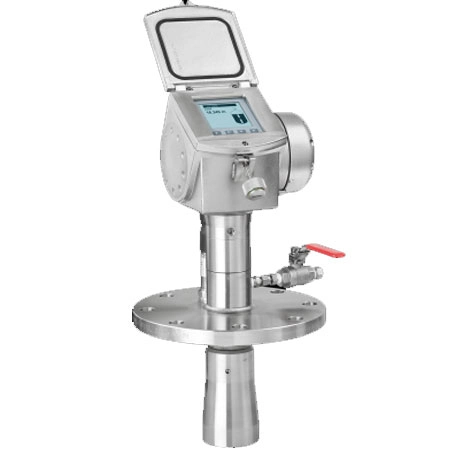
  • OPTIWAVE 6500 C

    Krohne Marshall’s range of radar level transmitters offer non-invasive measurement for liquids, pastes, granules, powders, and various solids. The radar principle used in these level meters is FMCW (Frequency Modulated Continuous Wave). They can measure distances of up to 100 meters (328 feet) and come with various antenna configurations designed for corrosive or abrasive substances, high pressure, high temperature, and agitator applications. They are also suitable for hazardous environments, functional safety (SIL), and hygienic uses.

    What are Radar (FMCW) Level Transmitters ?

    Radar (FMCW) Level Transmitters are designed for the non-contact, continuous measurement of levels in liquids, pastes, slurries, and bulk solids. These devices function using the Frequency Modulated Continuous Wave (FMCW) method, where a high-frequency radar signal is emitted with a frequency that rises linearly across a set bandwidth. As this radar wave bounces off the surface of the medium, the transmitter determines the precise frequency gap between the outgoing and incoming signals. This difference in frequency is directly proportional to the distance from the sensor. By employing Fast Fourier Transform (FFT) within an internal digital signal processor, the device can then calculate highly precise data for level, volume, or mass.

    Advantages of FMCW radar technology

    FMCW radar technology offers a key benefit i.e. outstanding reliability within challenging process environments. These transmitters remain entirely unaffected by changes in temperature, pressure, density, viscosity, or surface foam because their measurements rely on time-of-flight distance rather than the physical characteristics of the media. Furthermore, FMCW radar uses a broad dynamic range and high signal dynamics to provide precise, stable readings even for low-reflective media, while successfully filtering out false echoes caused by tank internal structures.

  • OPTIWAVE 7400 C

    Krohne Marshall’s range of radar level transmitters offer non-invasive measurement for liquids, pastes, granules, powders, and various solids. The radar principle used in these level meters is FMCW (Frequency Modulated Continuous Wave). They can measure distances of up to 100 meters (328 feet) and come with various antenna configurations designed for corrosive or abrasive substances, high pressure, high temperature, and agitator applications. They are also suitable for hazardous environments, functional safety (SIL), and hygienic uses.

    What are Radar (FMCW) Level Transmitters ?

    Radar (FMCW) Level Transmitters are designed for the non-contact, continuous measurement of levels in liquids, pastes, slurries, and bulk solids. These devices function using the Frequency Modulated Continuous Wave (FMCW) method, where a high-frequency radar signal is emitted with a frequency that rises linearly across a set bandwidth. As this radar wave bounces off the surface of the medium, the transmitter determines the precise frequency gap between the outgoing and incoming signals. This difference in frequency is directly proportional to the distance from the sensor. By employing Fast Fourier Transform (FFT) within an internal digital signal processor, the device can then calculate highly precise data for level, volume, or mass.

    Advantages of FMCW radar technology

    FMCW radar technology offers a key benefit i.e. outstanding reliability within challenging process environments. These transmitters remain entirely unaffected by changes in temperature, pressure, density, viscosity, or surface foam because their measurements rely on time-of-flight distance rather than the physical characteristics of the media. Furthermore, FMCW radar uses a broad dynamic range and high signal dynamics to provide precise, stable readings even for low-reflective media, while successfully filtering out false echoes caused by tank internal structures.

  • OPTIWAVE 8300 C Marine

    Krohne Marshall’s range of radar level transmitters offer non-invasive measurement for liquids, pastes, granules, powders, and various solids. The radar principle used in these level meters is FMCW (Frequency Modulated Continuous Wave). They can measure distances of up to 100 meters (328 feet) and come with various antenna configurations designed for corrosive or abrasive substances, high pressure, high temperature, and agitator applications. They are also suitable for hazardous environments, functional safety (SIL), and hygienic uses.

    What are Radar (FMCW) Level Transmitters ?

    Radar (FMCW) Level Transmitters are designed for the non-contact, continuous measurement of levels in liquids, pastes, slurries, and bulk solids. These devices function using the Frequency Modulated Continuous Wave (FMCW) method, where a high-frequency radar signal is emitted with a frequency that rises linearly across a set bandwidth. As this radar wave bounces off the surface of the medium, the transmitter determines the precise frequency gap between the outgoing and incoming signals. This difference in frequency is directly proportional to the distance from the sensor. By employing Fast Fourier Transform (FFT) within an internal digital signal processor, the device can then calculate highly precise data for level, volume, or mass.

    Advantages of FMCW radar technology

    FMCW radar technology offers a key benefit i.e. outstanding reliability within challenging process environments. These transmitters remain entirely unaffected by changes in temperature, pressure, density, viscosity, or surface foam because their measurements rely on time-of-flight distance rather than the physical characteristics of the media. Furthermore, FMCW radar uses a broad dynamic range and high signal dynamics to provide precise, stable readings even for low-reflective media, while successfully filtering out false echoes caused by tank internal structures.

Go to Top