2.5% fuel saved by improving boiler efficiency for a textile plant in India using Forbes Marshall Digital
A textile manufacturing plant in Tamil Nadu, India was facing variations in its boiler efficiency. Their partnership with Forbes Marshall Digital began in April 2025 with a shared objective of improving and sustaining boiler efficiency using EverSense for Boiler Efficiency, a Forbes Marshall Digital sustenance service.

PROBLEM
The boiler was operating at a low load of 34%
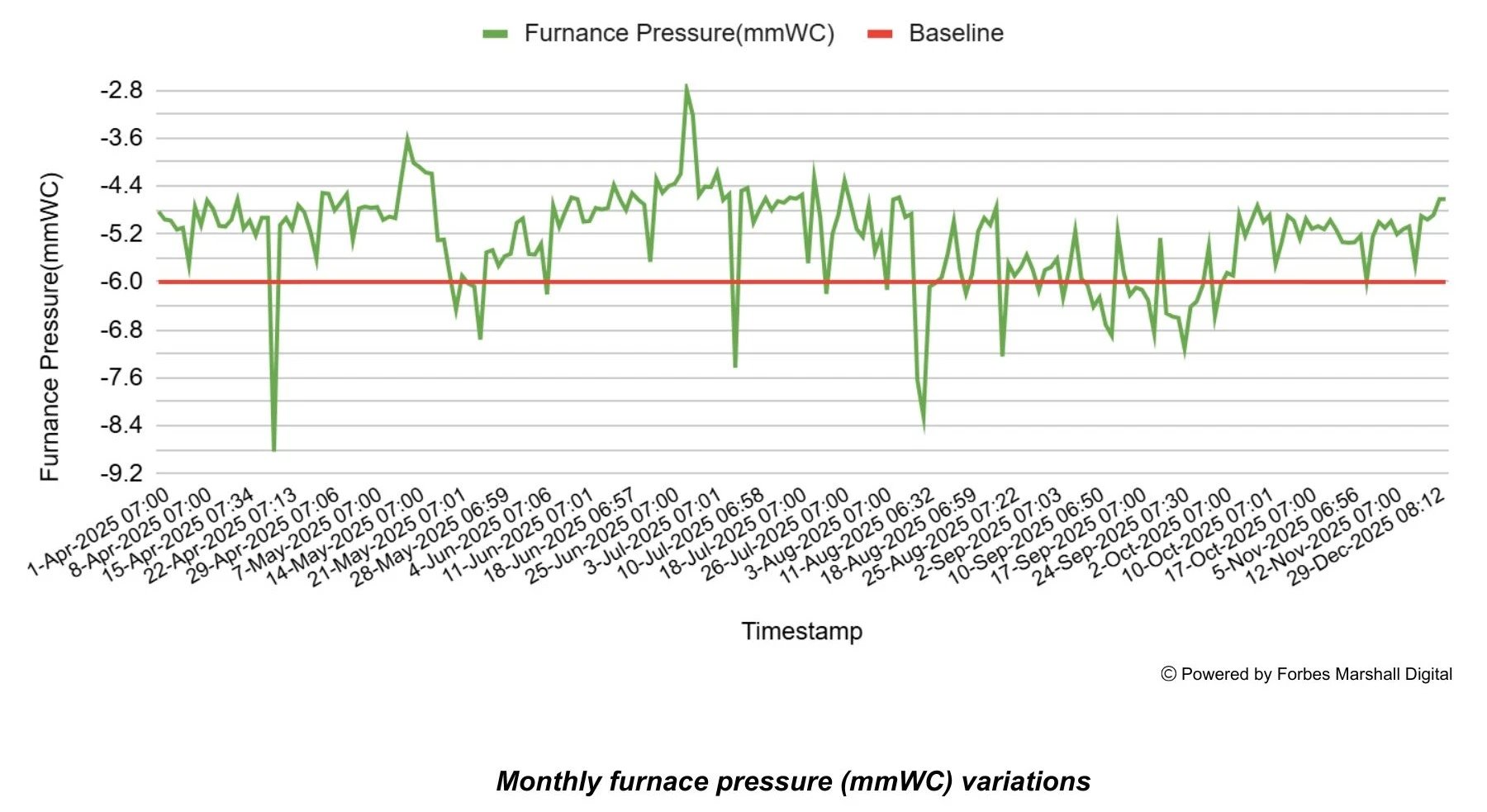
High furnace pressure at -6.0 mmWC was observed
Frequent boiler ON/OFF cycling observed 2-3 times per hour
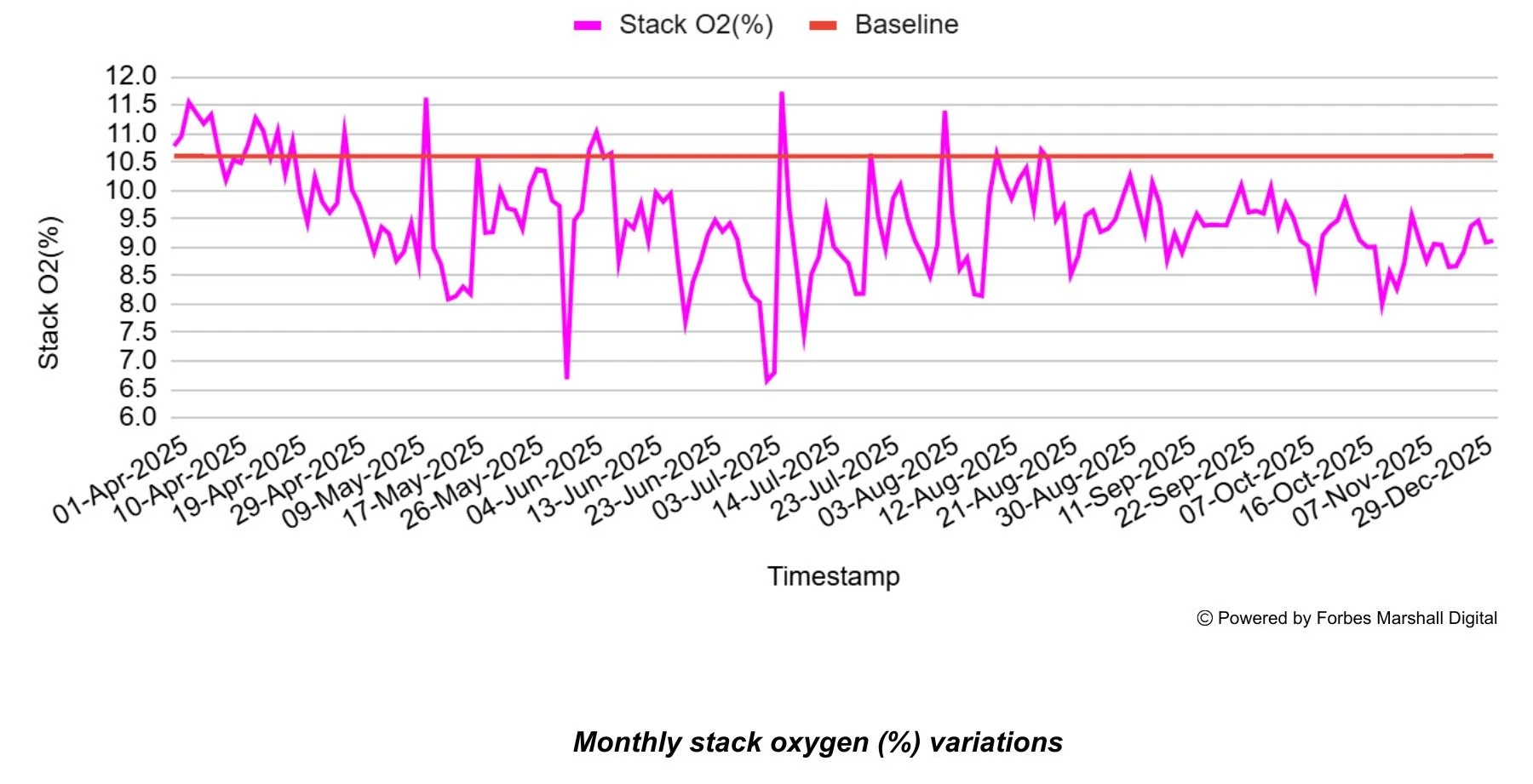
High stack oxygen levels (ranging from 10.1% to 10.6%)
A sudden increase in cold make-up water caused a sharp drop in feedwater temperature.
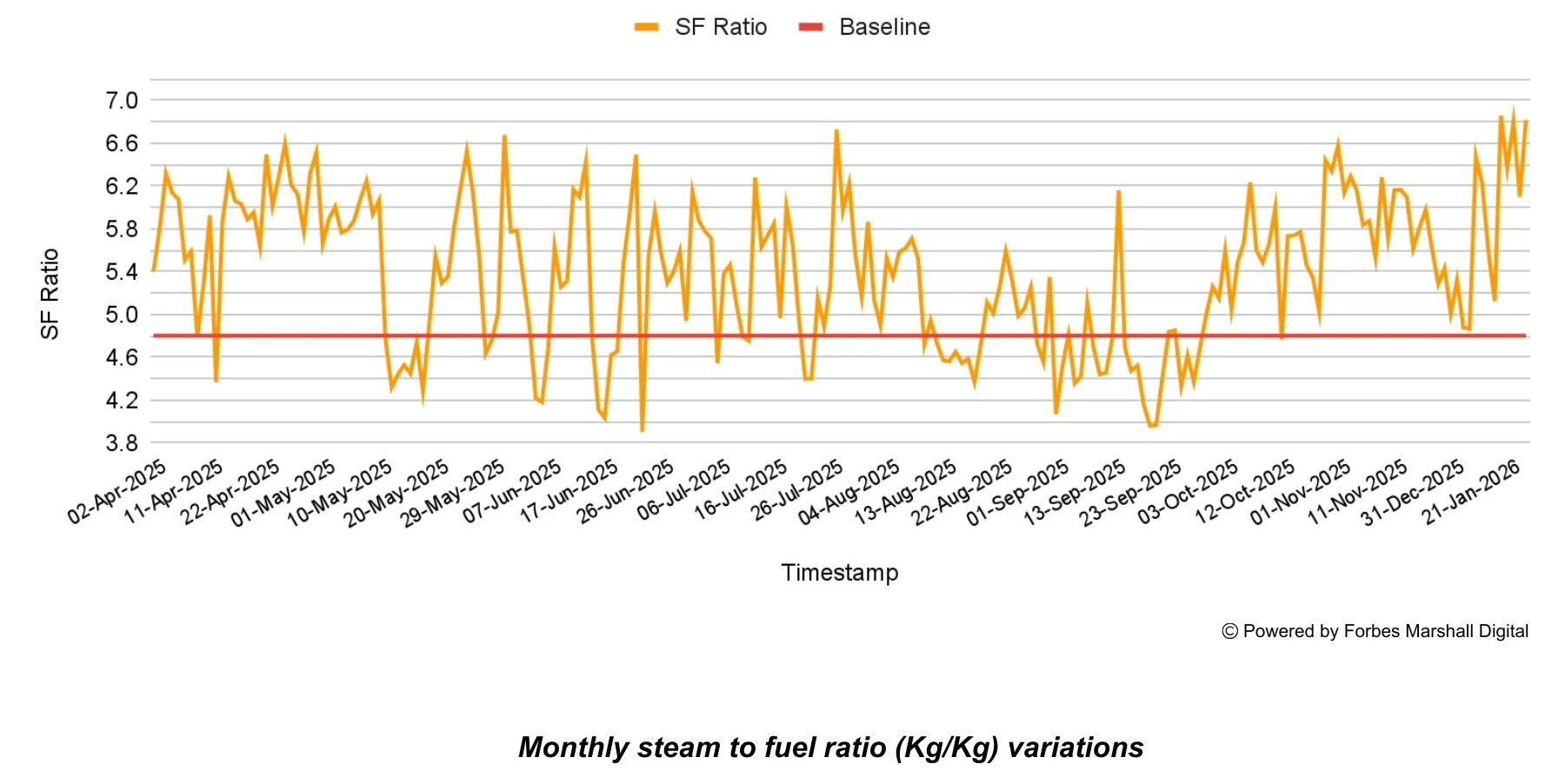
Low steam to fuel ratio (S:F) at 4.8 Kilograms/Kilogram (10.5 Pounds/Pound)
Boiler efficiency dropped to 80%, below optimal operating benchmarks
Blowdown TDS was being entered manually

SOLUTION
Reduced steam pressure setpoint by 2 bar, increasing operating load to the 40-60% band and lowering boiler ON/OFF cycling to ~1.5 cycles/hour for stable operation.
Optimised furnace draft by reducing ID fan speed by 2-3% and tuning combustion parameters to maintain draft within -4 to -5 mmWC.
Carried out oxygen sensor cleaning and calibration, along with fuel quality checks. Optimised FD fan VFD settings, reducing fan speed by 2-3% and reducing stack oxygen from 10.5% to 9.3%.
Enabled auto blowdown with continuous TDS control, minimising excess blowdown and reducing water and fuel losses.
Fine-tuned make-up water float sensor to control the make-up water cycle, stabilising feedwater temperature.
Improved steam to fuel ratio through increased feedwater temperature resulting in enhanced boiler efficiency.
BENEFITS
Reduced ON/OFF cycling to ~1.5 cycles/hour.
Reduced stack oxygen from 10.6% to 9.3%, resulting in improved combustion efficiency and lower excess air losses.
Optimised furnace draft from -6.0 mmWC to -4 to -4.8 mmWC, reducing unburnt fuel losses and improving heat utilisation.
Improved boiler performance by reducing fuel consumption through ID/FD fan optimisation and burner fine-tuning.
Reduced blowdown losses by shifting from manual to auto blowdown with continuous TDS monitoring leading to water, heat, and fuel savings.
Increased and sustained feedwater temperature from 77°C to 80°C (170.6-176 °F).
Increased steam to fuel ratio from 4.8 to 5.5 Kilograms/Kilogram (10.5-12.1 Pounds/Pound), resulting in 14.5% fuel savings.
Boiler efficiency improved from 80% to 82%, achieving a 2.5% efficiency gain.
Products
Associated Services

Process Optimization

Improving Uptime

Forbes Marshal Digital
Associated Services
What to read next